Why the standard office has had its day—but is still around
The standard German office from the 1960s to the 1990s. Still surprisingly prevalent.
Who isn’t familiar with it?
Long corridors, doors on both sides. Dark gray needle felt carpet. Suspended plasterboard coffered ceiling, white walls. Perhaps recently renovated, but still old-fashioned.
Numerous properties like this are available to rent. The stock and supply seem endless.
What is definitely endless here is the boredom. Or even worse: the discomfort of working in these rooms. Especially for employees of generations Y and Z.
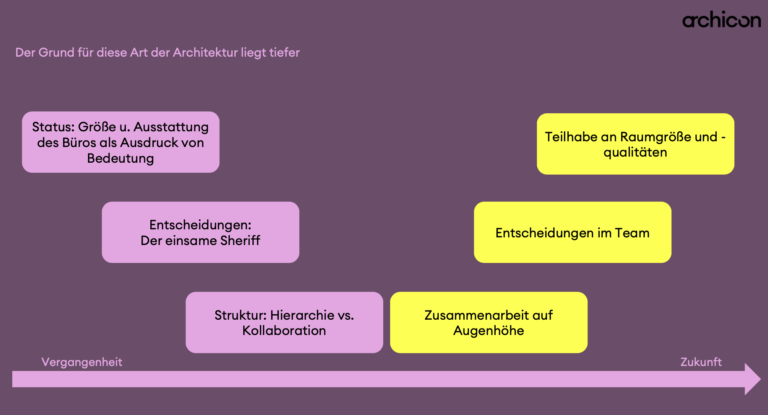
But why is that actually the case? For at least 15 years, we have been experiencing a fundamental change in the way we work together. The “Homo Officeticus” as we knew it for decades no longer exists. The department head who acted as a lonely sheriff and made decisions in his office that were prepared by a group of independent and competing employees.
Today, work and decision-making are done differently: more collaboratively, with more co-determination, on an equal footing, and in a hybrid manner. Young employees in particular are unfamiliar with any other form of collaboration. For them, it is a shock to be placed in a small office with a closed door and only see other colleagues when they go to get tea or coffee from the kitchenette or muster up the courage to knock on closed doors. And as a manager, not knowing that you have the support of your team when making decisions.
But today’s form of collaboration is not supported in the slightest by the standard layout of the German office. The office of yesterday is simply not suited to the work of today and tomorrow. That’s because old offices were designed and coded for a different way of working. For working in a finely divided manner according to status and hierarchies. An office axis with more space for the boss. A better telephone and a larger desk after years of successful self-sacrifice. And finally, for the division manager, an anteroom with an assistant.
Even with considerable effort, old office buildings cannot be easily converted into New Work spaces because they are fundamentally different in structure. They often lack the necessary depth for open-plan offices with activity-based zoning.
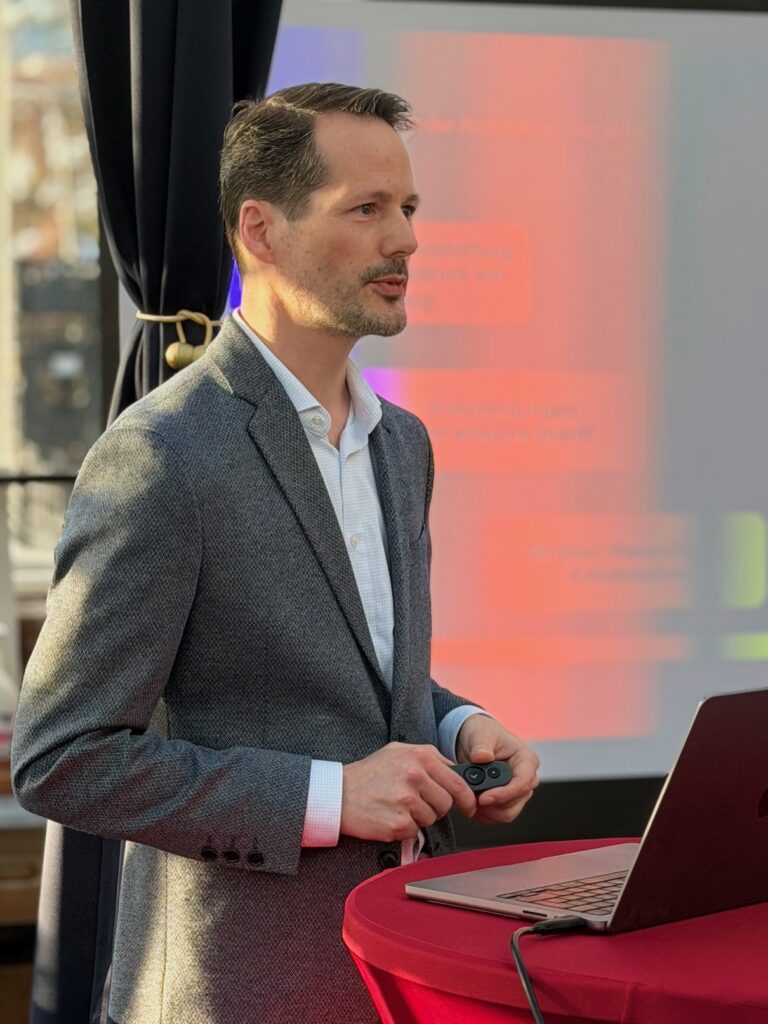
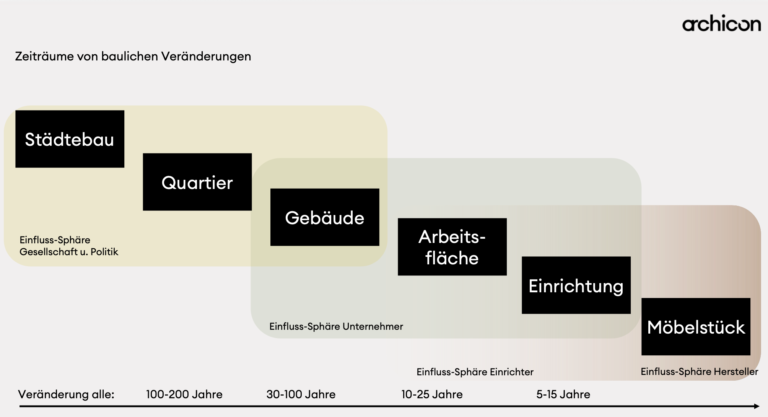
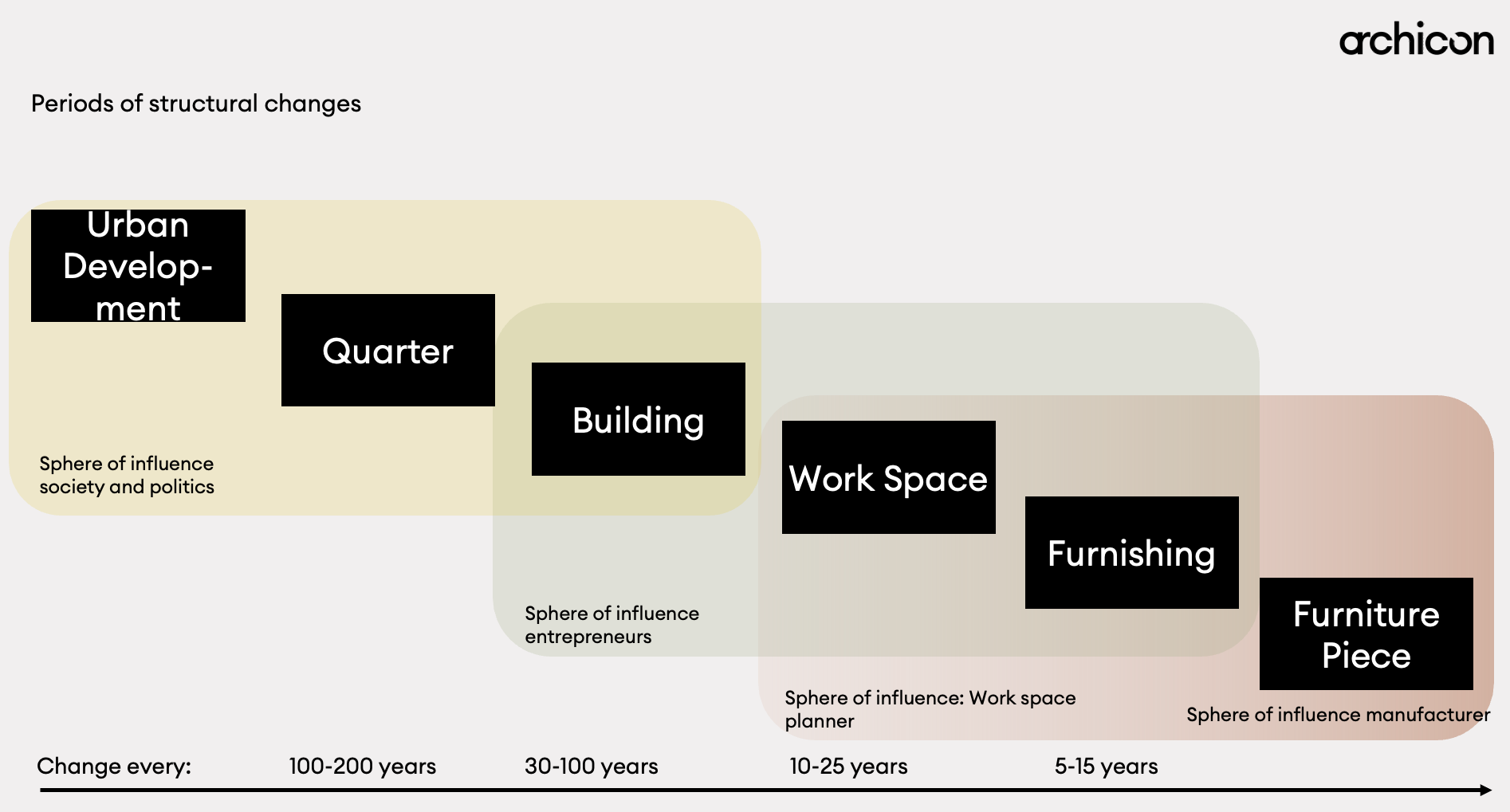
I highlighted this growing discrepancy in a presentation to entrepreneurs. It stems from the simple fact that our office space is enormous, and the investment opportunities and practical implementation options for major structural changes are simply not nearly sufficient to accommodate new collaborative working methods on a larger scale. The periods of time in which significant building stock can undergo fundamental change span decades. Too slow.
Some therefore seek and find the quick way out: no wonder start-ups are so keen to move into old industrial halls. There they find large open spaces with sufficient depth to create activity-based working environments. But these are rare and the supply is tiny.
The sluggishness of the transition means that providers of workspaces on the one hand and entrepreneurs on the other currently find little common ground for doing business with each other. You have to make do. Make the best of it. Unfortunately, that is often not enough.
So what can be done to bridge this gap?
Landlords of office space must be aware that they can only retain new tenants in the long term and on favorable terms if they adapt their space to today’s working practices as far as possible. Most of them believe that they can get away with superficially renovating their office space for new tenants. A new carpet. A new kitchen. Maybe new sinks in the restrooms. But making structural changes to the space? A bottomless pit. But it is precisely these steps that would make the space truly future-proof. In the end, this even delays the transition. Anyone who looks at the relevant portals on the internet will quickly see that there is a large supply of precisely these spaces. But very few potential tenants are satisfied with them. It is more a case of choosing something reasonably acceptable than pure joy at finding a truly suitable, attractive space.
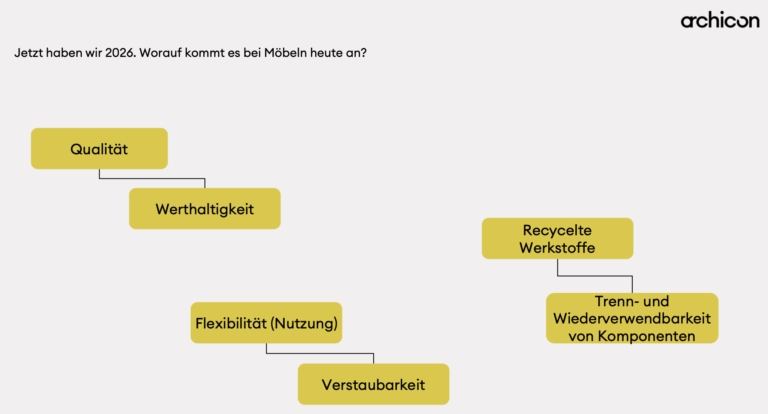
Good interior design and the right furniture can help to significantly improve the situation when room structures are inadequate. And basic values such as good ergonomics in the workplace and multiple uses of existing rooms can also be easily implemented in existing properties if an intelligent room concept is developed.
At Archicon, we are committed to finding the right furnishings for the right budget and, as far as possible, transforming spaces into customized workspaces that suit the company. Acoustic optimization is also an integral part of modern offices.
Talk to us, we are happy to help!